



Why Businesses Fail Cyber Insurance Claims
What business owners, CFOs, and COOs should validate before renewal
A cyber insurance policy can be valuable, but it is not a blank check. When a loss occurs, the insurer looks at the policy wording, the application, the facts of the incident, and the evidence the business can provide.
That matters because a claim can be delayed, reduced, disputed, or denied for reasons that have less to do with the size of the attack than with what the organization said it was doing before the incident.
The stakes are real. Coalition’s 2026 Cyber Claims Report found that business email compromise and funds-transfer fraud accounted for 58% of the claims it observed across more than 100,000 policyholders in 2025. At-Bay’s 2026 InsurSec Report found that businesses with less than $25 million in revenue saw ransomware frequency rise 21% year over year and average ransomware severity increase 40% to $422,000. These are insurer-specific datasets, but they reinforce a clear business point: smaller organizations can face losses large enough to disrupt operations.
The lesson is not simply “buy more insurance.” It is “make sure the coverage you buy matches the business you actually operate.”
1. The application says a control exists, but reality is different
Cyber insurance applications increasingly ask detailed questions about security controls. Marsh’s current Cyber Accelerate guidance lists topics such as multifactor authentication, patching, employee training, backups, incident history, payment processes, and encryption.
Those answers matter. In Travelers Property Casualty Co. of America v. International Control Services, Travelers alleged that the insured had overstated its use of multifactor authentication. After a ransomware event, the parties agreed to rescind the policy, and the court entered an order declaring it void from inception. The case ended by agreement rather than a trial decision, but the business lesson is useful: an application should describe the environment as it exists, not as leadership assumes it exists.
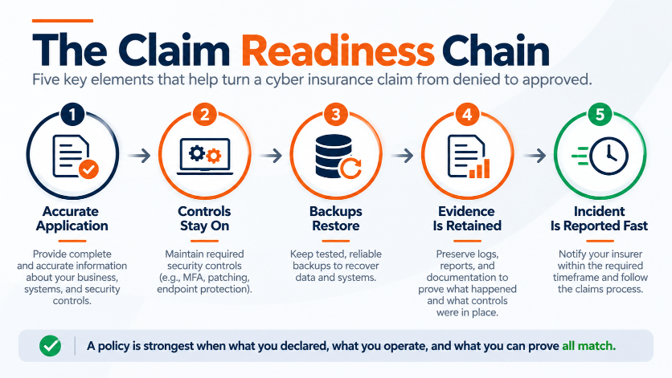
Before renewal, have IT validate every security-related answer.
2. MFA is enabled in some places, but not where it matters most
CISA recommends MFA across business email, file storage, remote access, and especially privileged or administrative access. That is not only a technical recommendation; it is a business-control issue because stolen credentials can expose critical systems.
A common management mistake is treating “we have MFA” as a yes-or-no question. The better question is: Which accounts and systems are protected, and can we prove it?
For Microsoft 365 environments, this matters because email, identity, SharePoint, OneDrive, and Teams often sit at the center of daily operations. Leaders do not need to understand every setting, but they should know whether appropriate identity controls are consistently applied.
3. Old or unsupported systems create a mismatch between risk and what was represented
The FTC recommends keeping operating systems, applications, browsers, and security software current and applying updates promptly.
Insurance applications commonly ask about patching and security maintenance. Running unsupported systems does not automatically mean a future claim will be denied; coverage depends on the policy. But it can create an underwriting concern or a credibility problem if the application suggests the environment is fully maintained when important systems are not.
Executives should know where unsupported technology exists, why it remains, and what the replacement or isolation plan is.
4. Backups exist, but they cannot actually restore the business
A backup is not proven because a job says “successful.” It is proven when the organization can restore the systems and data it needs within a timeframe the business can tolerate.
The FTC recommends regular backups and recovery planning. Coalition’s 2026 claims data also showed that 86% of businesses affected by ransomware in its dataset refused to pay the ransom, which the insurer linked to improved resilience, including viable backups and incident-response planning.
For leadership, the question is simple: When was the last successful restore test, what was restored, and how long did it take?
5. The business cannot produce evidence of the controls it says it has
During a claim, memory is weak evidence. Documentation is stronger.
Useful evidence may include MFA coverage reports, patch-compliance records, backup and restore-test logs, security-awareness records, incident-response plans, vendor responsibilities, and change records showing when controls were implemented.
This is why the cyber insurance renewal should not be owned by finance or the broker alone. Finance, operations, IT, and the insurance advisor should compare the application against current evidence before it is signed.
6. The incident is handled outside the policy process
Cyber policies may include notification requirements, consent provisions, approved-provider requirements, sublimits, or specific procedures for engaging legal, forensic, ransomware, or recovery services. Details vary by carrier and policy.
Do not assume the right first move is to hire vendors, negotiate, or make payments independently and sort out coverage later. Know the insurer’s reporting process before an incident occurs and include it in the response plan.
Coalition’s 2026 report noted that faster reporting of funds-transfer fraud improves the likelihood of recovering stolen money. The broader lesson is the same: speed and process matter.
What leaders should do before renewal
Treat renewal as a business-readiness review, not a paperwork exercise.
Ask IT to validate the answers. Test a meaningful restore. Identify unsupported systems. Confirm MFA coverage. Gather evidence. Review claim-notification and vendor requirements with your broker. Then have the appropriate executive sign the application only after the answers have been verified.
ICG’s Cybersecurity for Small Businesses: The Complete Guide provides a broader framework for evaluating the controls that reduce business risk before an incident occurs.
Cyber insuranceworks best when the policy, the security program, and the evidence all tell thesame story.
If your renewal is approaching, ICG can help you validate your current cybersecurity posture, identify gaps that may create avoidable risk, and organize the technical evidence your leadership team and insurance advisor need. Schedule a Cyber Posture Review.

Frequently Asked Questions
Why would a cyber insurance claim be denied?
Reasons vary by policy, but disputes can involve inaccurate application information, exclusions, failure to meet policy conditions, late notice, unapproved expenses, or a loss that does not fall within the purchased coverage.
Can missing MFA cause a cyber insurance claim to fail?
Potentially. If MFA was represented as being in place, required by the policy, or material to underwriting, a gap can create a serious coverage issue. The exact outcome depends on the policy and facts.
Do backups guarantee ransomware coverage?
No. Backups reduce operational risk, but insurance coverage depends on policy terms. Businesses should also test restores so they know the backups can support recovery.
What records should we keep for cyber insurance?
Keep evidence that supports application answers and security practices, such as MFA reports, patch records, backup tests, training records, incident-response plans, and relevant vendor documentation.
Should IT review the cyber insurance application?
Yes. Security-related answers should be verified by the people who manage the systems, with leadership, finance, and the insurance advisor aligned before the application is signed.


.png)