




Choosing a managed IT provider is one of the most consequential decisions a business owner can make — and one of the easiest to get wrong.
The wrong provider leaves you with reactive support, unresolved issues, and a technology environment that slowly drifts further from where it needs to be. The right one becomes a genuine partner: improving your security posture, stabilizing your infrastructure, and giving you confidence that IT is actually working for your business.
This guide gives you a practical framework for evaluating your options —including the questions most business owners forget to ask.
Why Most Provider Evaluations Focus on the Wrong Things
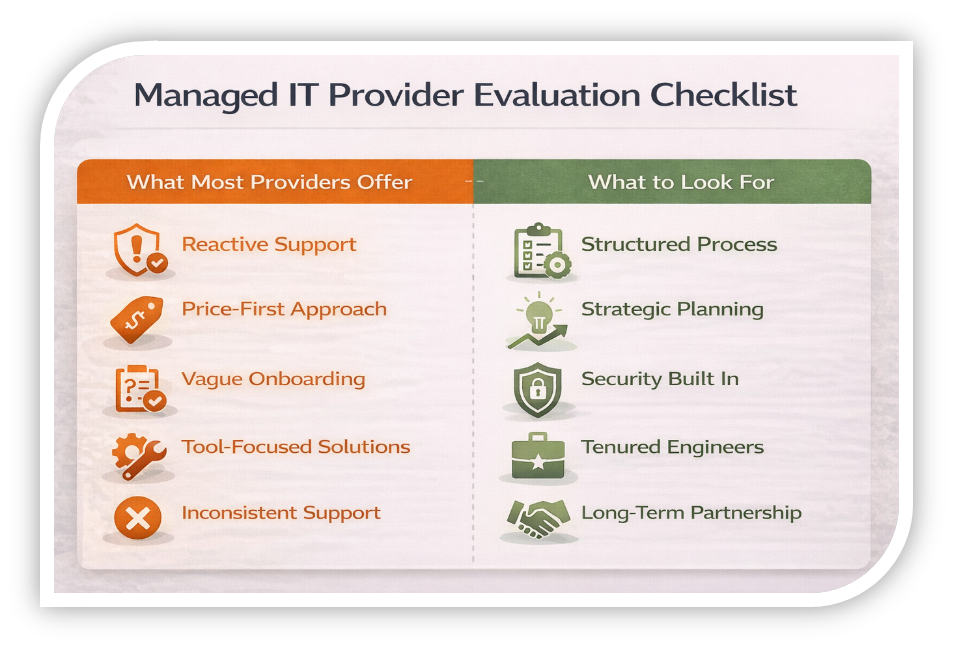
When businesses shop for a managed IT provider, the conversation usually gravitates toward price, response time, and a list of tools the provider uses. Those things matter, but they don't tell you nearly enough.
What actually determines your experience — and your outcomes — is the provider's process, their onboarding approach, and whether their team has the depth to support you consistently over time. A provider with a polished sales pitch and a low monthly price can still leave you worse off than when you started if the fundamentals aren't there.
The questions below are designed to surface what a proposal or sales call won't show you on its own.
Questions to Ask Every Provider You Evaluate
1. What does your onboarding process look like — in detail?
This is the most important question you can ask. A provider who gives a vague answer ("we'll get you set up in the first few weeks") is telling you something important: they don't have a structured process.
A mature provider should be able to walk you through exactly what happens from day one — what gets documented, what gets assessed, what gets addressed and in what order, and what the first 30, 60, and 90 days look like for your team. The answer should feel organized, not improvised.
2. How do you handle the transition from our current provider?
Switching IT providers is the moment most businesses dread. Ask specifically how the provider manages the knowledge transfer, how they get up to speed on your environment, and what they do to minimize disruption to your team during the transition. A provider that does this well has done it many times before — and it shows.
3. Who will actually be supporting us day to day?
Some providers sell you on experienced engineers and deliver offshore or entry-level support once the contract is signed. Ask directly about the team you'll be working with — their tenure, certifications, and whether you'll have consistent points of contact or a rotating help desk. Consistency matters. The engineer who knows your environment is more valuable than one who has to start from scratch every time.
4. What does your security stack look like, and how is it managed?
Cybersecurity is no longer a separate conversation from IT support — it's part of it. Ask how security is built into their standard service delivery, not offered as an upsell. A provider worth working with should be able to describe a layered approach to protection: endpoint security, identity management, email filtering, patch management, and ongoing monitoring, at minimum.
5. How do you approach strategic planning for clients?
Reactive IT support is table stakes. What separates a real partner from a vendor is whether they help you think ahead. Ask if they provide technology roadmaps, regular business reviews, and input on how your IT investment should evolve as your business grows. If the answer is no, you're buying a help desk —not a partner.
6. Can you describe a client you've worked with for five or more years?
Long-term client relationships are one of the clearest signals of a provider's quality. A business doesn't stay with an IT provider for five or ten years by accident. Ask about tenure, ask why clients stay, and if possible, ask to speak with a reference.
Red Flags to Watch For
Not every red flag is obvious in a proposal. Here are the ones that matter most:
- Vague onboarding language. If they can't describe the first 30 days in specific terms, they don't have a structured process.
- Price that seems too low. Extremely low pricing usually means corners are being cut — on staffing depth, security tools, or both.
- No mention of cybersecurity in the base offering. Security should be built in, not treated as an optional add-on.
- High engineer turnover or offshore-heavy staffing. Consistency and institutional knowledge matter in IT support. Ask directly.
- No strategic component. If the conversation never moves beyond ticket response times, you're looking at a help desk, not a partner.
- Pressure to sign quickly. A confident provider doesn't need to rush your decision. They let their process and track record do the talking.
For a broader look at how to protect your business from cybersecurity risk, read our complete guide: Cybersecurity for Small Businesses: The Complete Guide
What a Good Onboarding Process Actually Looks Like
The onboarding experience is where most providers reveal whether they've done this before or are figuring it out as they go.
A well-structured onboarding should accomplish several things without disrupting your business: document your full IT environment, assess your current security posture, identify gaps and risks, standardize your systems where needed, and put your team in a better position than they were in before the transition. Done right, your staff should barely feel the change — but the environment behind the scenes should be significantly better organized by the end of it.
If a provider is promising minimal disruption but can't explain what they're actually doing during onboarding, be skeptical. Minimal disruption is the outcome of a thorough process, not a substitute for one.
Why Process Matters as Much as Price
Two providers can quote you the same monthly fee and deliver completely different outcomes. The difference usually comes down to whether they have a repeatable, documented process — or whether they're reacting to issues as theycome up.
A process-driven provider stabilizes your environment first, then worksto standardize your systems and documentation, and then focuses on modernizing your infrastructure over time. That progression matters. Without it, even atechnically capable team ends up constantly fighting fires instead of movingyour business forward.
When you're evaluating proposals, ask yourself: does this provider have a framework for improvement, or are they just promising to keep things running?
ICG's Approach: Built Around Process and Partnership
ICG has been helping businesses stabilize, standardize, and modernize their technology environments since 1977. Our clients — many of whom have worked with us for more than a decade — don't stay because they have to. Theystay because the relationship works.
Our onboarding process is designed to be thorough without being disruptive. In the first 30 days, we document your full environment and establish the foundation. From there, we work through a structured progression— addressing gaps, improving security, and modernizing your infrastructure overtime — so that every month your environment is in better shape than the month before.
Our engineers are tenured, certified, and cross-trained. You'll work with a consistent team that knows your business, not a rotating cast of help desk agents starting from scratch on every call. And our security approach is built into the foundation of how we work — not sold to you separately after you've already signed.
If you're evaluating IT providers right now and want to understand exactly how ICG approaches your specific environment, we'd welcome the conversation.

Ready to See How ICG Compares?
We offer a no-pressure cybersecurity and IT posture review for businesses that want an honest picture of where things stand — and what a better IT relationship could look like.
Schedule Your Cybersecurity PostureReview →
Frequently Asked Questions
How long does it take to switch managed IT providers? A well-managed transition typically takes 30 to 60 days from contract signing to full onboarding completion. The timeline depends on the size of your environment and the complexity of your current setup. A structured provider will give you a clear timeline upfront —not a vague estimate.
Will switching IT providers disrupt our business? When the transition is handled correctly, disruption is minimal. A good provider has a documented process for taking over an environment, getting up to speed quickly, and keeping your team operational throughout. The key is choosing a provider that has done this before and can show you how they manage it.
What should be included in a managed IT contract? At minimum, your agreement should clearly define response and resolution time commitments, what's included in the monthly fee versus what triggers additional charges, how security is handled, how the onboarding process works, and what the exit process looks like if you ever need to make a change.
How do I evaluate a managed IT provider's cybersecurity capabilities? Ask specifically how security is built into their standard offering — not what they can sell you separately. A capable provider should be able to describe their approach to endpoint protection, identity management, email security, patch management, and monitoring without prompting. If those topics don't come up naturally in the conversation, that's a signal.
How much should managed IT services cost for a small business? Pricing varies based on the size of our environment, the level of security included, and the depth of support provided. Be cautious of pricing that seems significantly below market — it usually reflects a reduction in staffing quality, security tools, or both. The right question isn't just "how much" but "what am I actually getting for this price."
What makes ICG different from other IT providers? ICG is a people-first, Microsoft-focused managed IT and cybersecurity provider founded in 1977. Our approach is built around a proven framework — Stabilize, Standardize, Modernize— that gives clients a clear roadmap rather than just reactive support. We're known for thorough, structured onboarding, tenured and certified engineers, and long-term client relationships that average over a decade.
.png)