



Why 2026 Is a Turning Point for SMB Cybersecurity
Cybersecurity in 2026 looks very different than it did even a year ago. Attacks are faster, more automated, and increasingly targeted at small and mid-sized businesses, not just enterprises.
For SMB leaders, this creates a difficult reality:
You’re facing enterprise-level threats with SMB-level resources.
This outlook breaks down what’s changing in 2026, what risks matter most to SMBs, and how businesses can protect themselves without overcomplicating or overspending.

1. SMBs Are No Longer “Too Small” to Target
In 2026, attackers are prioritizing SMBs because:
- SMBs often lack 24/7 monitoring
- Ransomware groups automate attacks at scale
- Credential theft via phishing remains highly effective
- Cloud misconfigurations are common
Key reality:
Attackers don’t need to breach everyone. They only need to breach the least prepared.
Free Resource: 2026 SMB Cyber Risk Checklist
Download a simple checklist to identify your biggest exposure areas before attackers do.
2. AI-Powered Attacks Are Becoming the Norm
Artificial intelligence is no longer just a defensive tool. In 2026, it’s being actively weaponized by attackers to:
- Create highly convincing phishing emails
- Bypass basic security controls
- Launch attacks faster than humans can respond
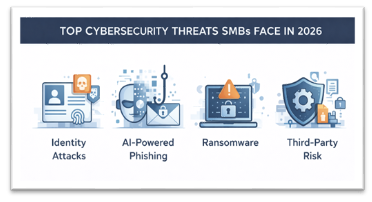
This means reaction-based security no longer works. If your business only responds after an alert or outage, you’re already behind.
3. Cloud Security Gaps Continue to Be Exploited
As more SMBs rely on Microsoft 365, cloud applications, and remote access:
- Misconfigured access controls
- Excessive user permissions
- Weak MFA enforcement
- Unmonitored admin activity
…are becoming top entry points for attackers.
Cloud-first businesses must be security-first businesses in 2026.
4. Compliance Pressure Is Increasing (Even for SMBs)
Cyber insurance providers, regulators, and customers are raising expectations.
In 2026, SMBs are being asked to show proof of:
- Multi-factor authentication
- Endpoint protection
- Continuous monitoring
- Incident response readiness
- Documented policies and procedures
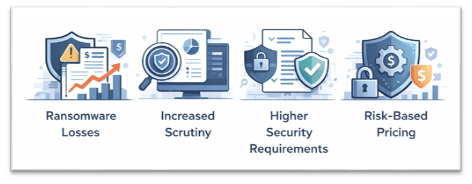
Security is no longer optional — it’s becoming a business requirement.
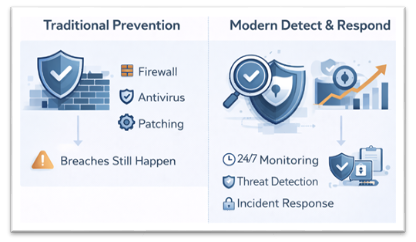
5. 24/7 Monitoring Is Shifting from “Nice-to-Have” to Essential
One of the biggest changes in 2026 is the expectation of continuous security monitoring.
Why?
Because most breaches now happen outside of business hours.
Without 24/7 visibility:
- Threats go undetected for days or weeks
- Ransomware spreads before action is taken
- Response becomes costly instead of contained
This is why Security Operations Centers (SOCs) and Managed Security Services (MSSPs) are becoming standard—not just for enterprises, but for SMBs as well.
6. The Cost of Prevention Is Now Lower Than the Cost of Recovery
In 2026, the math is clear:
- Average SMB breach costs exceed $200,000
- Downtime costs thousands per hour
- Reputation damage lingers far longer than the incident
Meanwhile, modern managed security models allow SMBs to access:
- Enterprise-grade tools
- 24/7 monitoring
- Threat response
- Compliance alignment
…at a predictable monthly cost.
Free Assessment: 2026 Cybersecurity Readiness Review
Understand where your business stands before attackers test it for you.
[Schedule Your Review]
What SMB Leaders Should Do Now
To stay ahead in 2026, SMBs should focus on:
- Proactive security instead of reactive fixes
- Continuous monitoring, not periodic checks
- Cloud security posture management
- Employee awareness and access control
- Partnering with experts instead of going it alone
How ICG Helps SMBs Navigate 2026 Securely
At ICG, cybersecurity is not an add-on—it’s built into how we support clients.

Every ICG client benefits from:
- 24/7 SOC monitoring and threat response
- Layered cybersecurity controls
- Cloud and Microsoft 365 security expertise
- Compliance-aligned security strategies
- A people-first, process-driven approach
We help SMBs face modern threats with confidence, clarity, and control.
Final Thought: Cybersecurity Is a Business Decision
2026 is not the year to “wait and see.”
The most resilient SMBs are the ones that treat cybersecurity as:
- A business continuity strategy
- A trust-building investment
- A competitive advantage
Ready to start 2026 with clarity instead of uncertainty?
Talk with ICG about building a cybersecurity strategy designed for today’s SMB realities.
👉 [Talk to an ICG Security Advisor]
.png)